


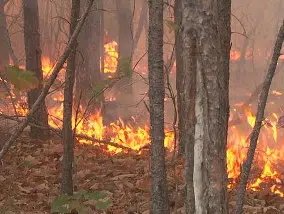
RHINELANDER, Wis. – Wildfire smoke continues to affect air quality across the region, leaving families wondering whether it’s safe for children to spend time outdoors. While smoky conditions can affect anyone, children are especially vulnerable because their lungs are still developing. Children with asthma, chronic lung disease or a history of premature birth may be among the first to experience breathing problems when air quality declines.
Wildfire smoke contains soot, ash and other fine particles that can irritate the lungs and airways. As the body works to clear those particles, children may develop coughing, congestion, wheezing, increased mucus production or shortness of breath.
“The bigger the particles, the bigger problem they cause because those particles get lodged in your lungs,” said Sarah Dennison, MD, a pediatrician with Aspirus Health. “Some kids will produce a lot of mucus in an effort to clear all that smoke, so they’ll become very stuffy with lots of drainage and a productive cough.”
For many parents, one of the biggest questions during smoky conditions is when it’s time to limit outdoor activities. While the Air Quality Index (AQI) can be a useful guide, Dr. Dennison says families should also pay attention to how a child is responding to smoky conditions.
“The first thing I ask patients is, ‘How do you feel?'” Dr. Dennison said. “If they feel pretty good, I tell them to stay hydrated and spend time where the air isn’t smoky. If they’re already feeling poorly, they absolutely need to stay inside.”
Reducing smoke exposure remains one of the best ways to protect children during periods of poor air quality. The U.S. Environmental Protection Agency (EPA) recommends keeping windows and doors closed, replacing furnace filters regularly and running a portable air purifier to help improve indoor air quality during smoky conditions. Families can also use recirculation settings on central air conditioning systems to reduce the amount of outdoor smoke entering the home. Parents of children with asthma should make sure medications are readily available and asthma action plans are up to date.
If children need to spend time outdoors for an extended period, a properly fitted N95 mask may help reduce exposure to smoke particles.
“If you’re going to wear a mask, it really should be an N95 mask that closes completely around the nose and mouth,” Dr. Dennison said. “Masks with openings on the sides or the top are going to let smoke and ash in, so they’re not going to be nearly as useful.”
Most children begin feeling better after getting out of smoky conditions, but persistent symptoms should not be ignored. Parents should watch for worsening cough, wheezing, chest tightness or shortness of breath, especially in children with asthma or other respiratory conditions.
“If they’re not feeling any better after getting out of the smoke, they really need to go to a clinic or emergency department so someone can evaluate what’s going on in their lungs,” Dr. Dennison said.
Because wildfire smoke conditions can change quickly, families should continue monitoring local air quality reports and paying close attention to how children are feeling. Current conditions and forecasts are available through the EPA’s AirNow website and mobile app. If symptoms worsen or do not improve after a child gets out of the smoke, parents should contact their health care provider. Children experiencing severe breathing difficulties should receive immediate medical attention.
BY-Matthew Thompson
###







Comments